Rob’s carved wooden bird Cricket
The Tiger RisingRob’s carved wooden bird Cricket is a handmade keepsake fashioned from Willie May’s memory of the green parakeet she once freed. Its importance lies not in pretending that a carving can replace a living animal, but in giving grief, affection, and the wish for freedom a tangible form: Willie May carries it, says it soothes her heart, and places it beside the tiger after its death. In Rob’s dream, the wooden bird becomes alive and flies out of the grave, joining loss to an image of release.
Origin and Making
Willie May tells Rob that, when she was little, her father brought her a tiny green parakeet in a cage. She could hold the bird in the palm of her hand and feel its heart beating. It cocked its head and sang so continually that she called it Cricket. The memory is intimate and physical: the bird’s smallness, its heartbeat, and its song remain vivid long after it is gone.
When Rob asks what happened to the parakeet, Willie May says that she let him go. She could not stand seeing him locked up, so she released him. Rob hears this account against the background of the tiger’s captivity, and the parallel gives the childhood story a present-tense weight. Cricket is not merely an old pet remembered for its charm; his release embodies Willie May’s refusal to accept a living creature’s confinement as an unchangeable condition.
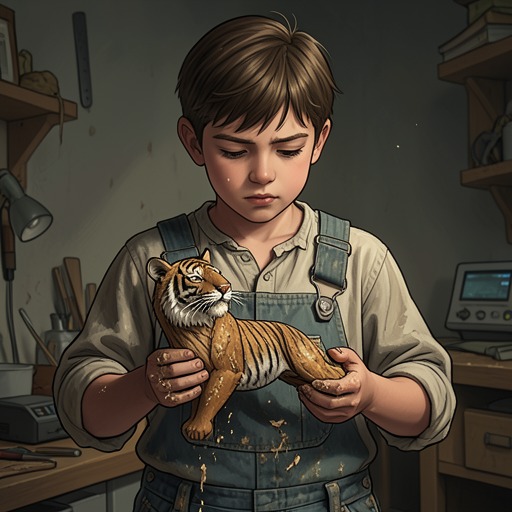
Rob makes the carving while concentrating on green leaves and recalling his mother’s description of green as the original color. He lets that color enter his thoughts through a crack in his suitcase of not-thoughts and wonders whether Willie May’s Cricket had been the same bright green. As he works, the wood takes shape under his knife: a wing, a beak, and a tiny eye emerge. He continues until the bird looks so real that he half expects it to sing. The carving’s details arise from the remembered parakeet, but the act of making also connects the bird to Rob’s own memory of his mother and to his effort to give feeling a form he can hold.
Gift and Recognition
Rob brings the wooden bird to Willie May, but, standing before her, he is afraid to give it to her. He worries that he has carved it wrong and that it does not look enough like the real Cricket. Before he loses his nerve, he tells her he has made something for her and asks her to close her eyes and hold out her hand. The hesitant presentation makes the gift an act of trust as well as craftsmanship: Rob offers something personal without knowing whether it will be accepted.
Willie May keeps her eyes closed after the bird is placed in her hand. She says she does not need to look because she knows what she is holding: Cricket. Only afterward does she open her eyes slowly, as if afraid she might frighten the bird into flying away. She recognizes the carving as the right bird, validating Rob’s attempt not through a visual test alone but through the remembered creature’s presence in her hand.
Rob acknowledges that a wooden bird is not the same as having a real one. Willie May agrees, but tells him that it soothes her heart just the same. Her response preserves the difference between living animal and carved object while affirming that the carving can still comfort her. She slips it into the front pocket of her dress, carrying the gift with her rather than treating it as a display piece.
The Bird Beside the Tiger
At the tiger’s funeral, after Rob says that he loved the animal, Willie May takes the wooden bird from her dress pocket. She explains that she has not had good experiences with animals in cages, then bends and lays Cricket on top of the tiger. Calling it a little bird to keep the tiger company, she steps back from the grave. The gesture brings her own history of captivity and release into the funeral: a keepsake made in memory of a freed bird is offered to an animal that died after being held captive.
The bird’s role here is both personal and relational. It carries Willie May’s remembered affection for Cricket, Rob’s labor and care in carving him, and a final expression of company for the tiger. The carving cannot undo the tiger’s death or substitute for the parakeet’s living body; its significance comes from the particular people and animals whose histories meet at the grave. Willie May’s decision to leave it there turns the private gift into part of a communal act of mourning.
Dream and Release
That night, Rob dreams that he and Sistine stand at the tiger’s grave, waiting without knowing what for. A flutter of green wings appears: the wooden bird is no longer made of wood but real. It flies up from the grave, and the two children chase it, laughing and bumping into each other, but cannot catch it. The bird climbs until it disappears into a sky resembling the ceiling of the Sistine Chapel. Sistine says in the dream that she had told him it was like fireworks. Rob wakes smiling and looking at the motel-room ceiling.
The dream reimagines the carving’s material limits without erasing the events that gave it meaning. The bird placed beside the tiger rises from the grave as a living creature, while its upward flight recalls both the parakeet’s release and the tiger’s lost freedom. Yet the bird remains elusive: the children can chase it but cannot possess or confine it. In this final image, Cricket links Rob’s act of making, Willie May’s memory, the tiger’s funeral, and an ending in which sorrow is joined by color, motion, and the possibility of joy.